
The Defence Acquisition Council, led by Defence Minister Rajnath Singh, has approved the procurement of military hardware worth an estimated Rs 1.10 lakh crore for the Indian Army, Navy, and Air Force. This significant move aims to enhance India's combat prowess and reduce dependency on foreign vendors, with approximately 98 per cent of procurements sourced from Indian industry.

India on Thursday approved capital acquisition of a plethora of indigenously-developed military hardware including indigenous BrahMos missiles, marine diesel engine, artillery gun system, electronic warfare suits and utility helicopters at a cost of Rs 70,584 crore as part of a mega procurement plan.

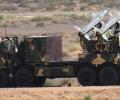
The approved proposals included "procurement of night sight (image intensifier), light vehicles GS 4X4, air defence fire control radar (light) and GSAT-7B satellite," it mentioned.
The procurement proposals were cleared at a time India and China are locked in a bitter border standoff in eastern Ladakh.

Europe has overtaken Asia as India's biggest arms supplier, reflecting New Delhi's evolving defence procurement strategy.

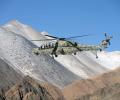
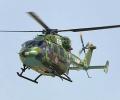
The cost of acquiring the advanced light helicopters from the state-run Hindustan Aeronautics Ltd (HAL) has been estimated at Rs 3,850 crore while a batch of rocket ammunition will cost Rs 4,962 crore, the defence ministry said.
The ministry also decided to dispense with the requirement of the Integrity Pact Bank Guarantee to reduce the financial burden on the Indian defence industry, a move aimed at promoting domestic manufacturing.

Russian President Vladimir Putin has offered New Delhi Russia's fifth-generation stealth aircraft Sukhoi Su-57 and even suggested that the combat jet could even be jointly produced in India in line with the strong strategic partnership between the two countries.
"The DAC accorded approval for procurement of equipment worth over Rs 5,100 crore from indigenous sources. These include sophisticated Electronic Warfare Systems for the Army designed by DRDO and manufactured locally by the Indian industry," the defence ministry said.

The Defence Acquisition Council (DAC) has approved military projects worth approximately Rs 67,000 crore, including drones, radars, and missile systems, aimed at enhancing India's military capabilities.
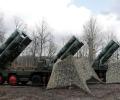
The Indian Defence Ministry has approved the procurement of weapons and military hardware worth Rs 2.38 crore, including S-400 missiles and medium transport aircraft, to bolster the Indian Air Force's capabilities.

India has approved proposals to procure weapons and military hardware worth Rs 79,000 crore, including Nag missiles, amphibious warfare ships, and electronic intelligence systems, to enhance the military's combat capabilities.
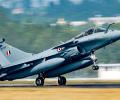
The Indian Defence Ministry has approved the procurement of 114 Rafale fighter jets from France, a significant step towards bolstering the Indian Air Force's combat capabilities. The decision comes ahead of French President Emmanuel Macron's visit to India.
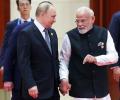
Prime Minister Narendra Modi will host Russian President Vladimir Putin for a private dinner and summit, focusing on defence, trade, and geopolitical issues, including the Ukraine conflict and the impact of US sanctions.

India and Russia have agreed to encourage joint manufacturing of military hardware and spare parts in India, aiming to improve maintenance of Russian-origin defence equipment and boost overall bilateral defence cooperation.

The IAF's future operational concepts could involve indigenous Tejas combat aircraft coordinating in real time with multiple Ghatak RPSAs, each carrying a different mission payload ranging from electronic warfare systems and targeting sensors to precision munitions.
The Southeast Asian nation has been focusing on modernising its military in the face of myriad security challenges as well as decades-long territorial disputes with China in the South China Sea.

A senior US official has emphasised India's crucial role in maintaining peace and stability in the Indo-Pacific region and ensuring a balanced power dynamic in Asia, advocating for stronger defence ties between the two nations.
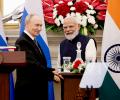
Russia, being bogged down by the Ukraine war and prioritising the requirements of its own armed forces, along with India's consistent diversification policy, will remain a major challenge to the bilateral partnership, note Harsh V Pant and Aleksei Zakharov.

In 2025-26, the government allocated Rs 6,81,210 crore for defence budget.
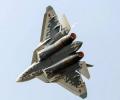
However, these are understood to be exploratory talks, with an agreement unlikely to be formalised during the current visit.
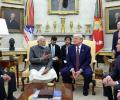
India and the United States have agreed to deepen their strategic partnership in several key areas, with President Donald Trump announcing plans to provide India with F-35 fighter jets and billions of dollars in military supplies. The two leaders also discussed energy cooperation, critical technologies, connectivity, and countering terrorism. They agreed to work together on the India-Middle East-Europe Economic Corridor, and Trump noted India's reforms to welcome US nuclear technologies. Prime Minister Modi said the two countries can shape a better world through their cooperation. Both leaders also addressed the Russia-Ukraine conflict, with Modi stressing India's commitment to peace.

General Rawat also said that adequate focus must be on ensuring that "trial procedure" for procurement of military equipment does not linger on for too long, in an indication of his unhappiness over the delay in modernisation of armed forces.
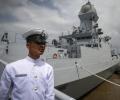
All the items identified for procurement from domestic defence manufacturers are used in shipbuilding. So far, the defence ministry has notified 127 items where purchase preference is given to local suppliers.
Even as the benchmark and broader indices were down sharply on Monday due to escalating tensions in West Asia, the Nifty Defence index ended the session in the green.
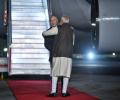
Russian President Vladimir Putin arrived in New Delhi for a two-day visit focused on strengthening ties with India, including defense cooperation and trade, amidst a changing geopolitical landscape.

Vance also hinted that the US may drop additional tariffs on countries if the US make a deal with Russia, and also apply more tariffs on the countries to bring this war to a close.

In a year bookended by intractable conflicts and geopolitical fragmentation, India focused on ramping up military prowess by broadly firming up defence procurement worth Rs 4.22 lakh crore even as Indian and Chinese militaries completed pulling back their troops from border face-off points in eastern Ladakh.

India and the United States have announced a groundbreaking 10-year defence partnership, paving the way for increased military cooperation and potential sales of F-35 stealth fighter jets. The agreement aims to bolster both countries' defence capabilities in the Indo-Pacific region, with plans for joint production of weapons and platforms. The move comes amid China's growing military presence in the region.
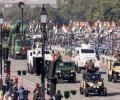
Under capital expenditure, Rs 48,614 crore has been set aside for aircraft and aero engines while Rs 24,390 crore has been allocated for the naval fleet.

US Vice President JD Vance called on India to drop non-tariff barriers, give greater access to its markets and buy more American energy products and military hardware. Vance, in a speech in Jaipur, highlighted the need for a stronger US-India partnership for a prosperous and peaceful 21st century. He emphasized the importance of working together to address global challenges and praised Prime Minister Narendra Modi, describing him as a "special person." Vance also urged India to provide greater market access to American products and buy more defense platforms and energy from the US. He suggested that India consider dropping some of the non-tariff barriers for American access to the Indian market and highlighted the benefits of closer India-US defense collaboration, advocating for New Delhi to procure more military hardware from the US. He cited the example of American fifth-generation F-35s, arguing they would give the Indian Air Force the ability to defend its airspace and protect its people like never before. Vance also welcomed the Modi government's budget announcement to amend India's civil nuclear liability laws, paving the way for US producers to export small modular reactors and build larger US-designed reactors in India. He emphasized the importance of energy security for India's AI ambitions, stating "there is no AI future without energy security and energy dominance." Vance's visit comes amid growing global concerns over the US's tariff war.
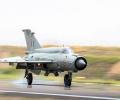
The MiG-21 episode demonstrates that procurement is always strategic.
Choices about what aircraft to acquire, who builds them, who supplies the spares, who trains the pilots and technicians are decisions with political consequences lasting for decades.
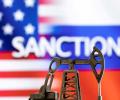
Russia has a "special mechanism" to confront any challenge arising out of the US slapping punitive measures against India for its procurement of Russian crude oil, Russian charge d'affaires Roman Babushkin said on Wednesday.

Low-level lightweight radars; very short-range air defence systems (launchers and missiles); remotely piloted aerial vehicles; loitering munitions, including vertical take-off and landing systems; different kinds of drones; bullet-proof vests; ballistic helmets; quick-reaction fighting vehicles -- heavy and medium; and night sights for rifles (aiming devices that are visible in low light).

Minister of State for Defence Ajay Bhatt said the major defence equipment that were imported included helicopters, aircraft radars, rockets, guns, assault rifles, missiles and ammunition.

In a major move in 2016, the US had designated India a "Major Defence Partner" intending to elevate defence trade and technology sharing to a level commensurate with that of its closest allies and partners.
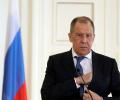
It is learnt that Lavrov is expected to travel to India either on Thursday or Friday after concluding a two-day visit to China.

The defence ministry said 98 per cent of the total procurement worth Rs 2.23 lakh crore will be sourced from the domestic industries.
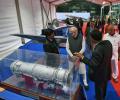
Defence Minister Rajnath Singh on Tuesday unveiled a new version of the procurement manual of the premier military research institute Defence Research and Development Organisation featuring simplified procedures for the involvement of the private sector in various research and development projects.

Every year over $1.5 trillion are spent on military expenditures worldwide.
